[The 21st Talking about the Human Rights of Older Persons] a Roundtable with the AGAC Global Advisory Group
작성자 ADMIN
날짜 2026-04-06 08:21:29
조회수 874
The ASEM Global Ageing Center (AGAC) held the “21st Dialogue and Roundtable with ASEM Experts on the Human Rights of Older Persons” on March 27, 2026, from 2:00 to 4:00 PM (KST) via Zoom.
The roundtable was conducted with the participation of AGAC’s Global Advisory Group, bringing together experts from academia, civil society, policy, and healthcare sectors representing Europe, Asia, and North America. Participants included Prof. Thanh Long Giang (National Economics University, Viet Nam), Prof. Titti Mattsson (Lund University, Sweden), Dr. Kai Leichsenring (former Executive Director of the European Centre for Social Welfare Policy and Research), and Ms. Margaret Young (former Chair of GAROP, Founder of Age Knowble, Canada), along with AGAC representatives including Dr. Chung Ha Suh (Executive Director), Dr. Sung Jae Choi (Chairperson of Board of Directors of AGAC, Professor Emeritus, Seoul National University), and Dr. Geun Koh (Operations Director).
The meeting commenced with welcoming remarks by Chairperson Choi, who expressed appreciation for the continued contributions of the Advisory Group. Dr. Suh delivered introductory remarks and shared expectations for future collaboration. Dr. Koh presented AGAC’s key activities and achievements in 2025, including policy research, international forums, and the publication of its periodical.
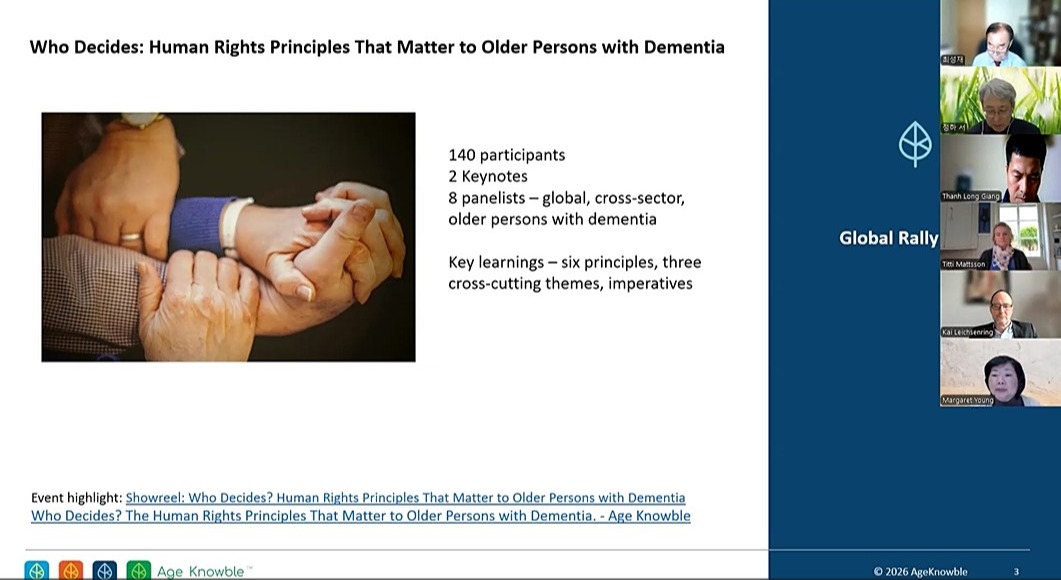
During the presentation session, participants shared recent research and policy developments.
Dr. Kai Leichsenring introduced ongoing preparatory research on elder abuse prevalence and studies on support for informal caregivers, highlighting the gap between policy frameworks and actual service delivery. He also discussed the case of Slovenia’s long-term care system, noting challenges in aligning policy design with implementation capacity.
Prof. Thanh Long Giang provided an overview of Viet Nam’s recent policy developments in response to rapid population ageing, including national strategies, expansion of social insurance, and strengthening of community-based care. He highlighted the “Intergenerational Self-Help Club” model and emphasized structural challenges commonly faced across Asian countries.
Prof. Titti Mattsson analyzed Sweden’s experience, focusing on increasing pressure on welfare systems, workforce shortages in care services, and regional disparities in service provision. She also addressed the growing role of artificial intelligence (AI) and digitalization in elderly care, emphasizing the need for accessibility and user-centered policy design.
Ms. Margaret Young focused on ongoing discussions toward a United Nations convention on the rights of older persons. She underscored the importance of establishing universal principles that reflect diverse cultural contexts and highlighted that principles such as “do no harm” can serve as guiding standards in future policy and technological applications.
The discussion session addressed AGAC’s future directions and key policy issues, including AI, ageism, human rights education, and international cooperation. Participants acknowledged that while technological advancements can improve the quality of life for older persons, they also introduce new human rights challenges, emphasizing the importance of a rights-based approach.
It was also noted that discussions on a UN convention on the rights of older persons are moving into the drafting stage, with an increasing role for civil society and expert networks. Addressing ageism, expanding human rights education, and promoting intergenerational engagement were identified as key policy priorities.
The roundtable served as an important platform for sharing knowledge and experiences among global experts and provided valuable input for AGAC’s policy direction. It also reaffirmed the importance of international cooperation in advancing the human rights of older persons amid rapid demographic, technological, and social changes. You may wish to refer to the attached file for further details.
AGAC will continue to strengthen collaboration with its Global Advisory Group and contribute to international policy discussions through ongoing research and dialogue.