[Case 35] “Age Helps” in Action: How Korea’s Nanumteo Reimagines Dignified Ageing
작성자 ADMIN
날짜 2026-06-22 16:01:16
조회수 697
[Case 35] “Age Helps” in Action: How Korea’s Nanumteo Reimagines Dignified Ageing
HelpAge Korea has a compact motto: “Age helps.” The private social-welfare foundation, affiliated with HelpAge International, works to support older persons’ rights, agency, and social participation, especially among those facing disadvantage. Behind the phrase is a simple reversal: older persons are not only people who receive help, but people who give it. The idea carries particular weight in Korea today, now a super-aged society, where seeing older persons mainly as recipients of welfare no longer fits the country’s realities.
The quality of later life cannot be secured by welfare support alone, however advanced or ample it may be. Social roles, relationships, and a sense of self-efficacy remain part of what makes life livable into old age. Recognizing older persons as active agents in their own lives and communities is therefore the starting point for any serious effort to advance their rights as participants and contributors.
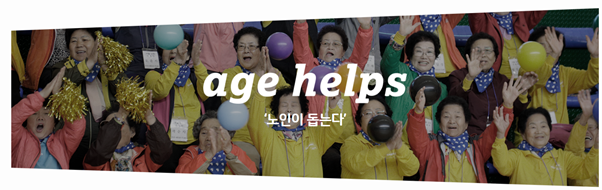
Source: HelpAge Korea official website
Yet there is a revealing irony. The support and training required to build independence early in life are largely taken for granted, while far less attention is paid to what it takes to regain that independence in later life. The contrast points to how limited our picture of older persons remains, with many still seen primarily as recipients of protection and support. That narrow view is often reinforced by the way many policies and programs are run—under deadlines and output targets. But restoring agency in old age is patient work. It cannot be hurried along by performance indicators. Like nurturing independence in early life, it requires time, resources, and a sustained belief in older persons’ capacity.
HelpAge Korea has tried to put that belief into practice through a range of programs. One of them is Nanumteo—literally, “a place of sharing”—a community-based group where older persons take part, govern themselves, and share with others. Inspired by a self-help group model for older persons in the Philippines, Nanumteo began in 2004 as a way for low-income older adults to form groups of their own, enter more fully into community life, and practice sharing. Since then, the model has been adjusted to the grain of Korean communities and has expanded across the country. Today, 20 Nanumteo groups are in operation: two managed directly by HelpAge Korea (Hwagok and Sinwol groups), and the rest run in partnership with 16 partner organizations[1].
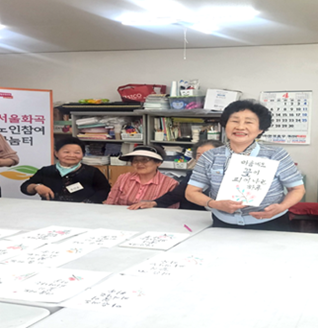
A calligraphy class at Hwagok Nanumteo. Source: AGAC
In May 2026, the ASEM Global Ageing Center (AGAC) visited the Hwagok and Sinwol Nanumteo groups in western Seoul to observe their activities and speak with older members and HelpAge Korea staff. What AGAC encountered there was the philosophy of “Age helps” with a pulse: alive in the ordinary rhythms of community life, in shared decisions, small acts of care, and the slow recovery of agency.
When the AGAC team entered Hwagok Nanumteo[2], what came into view was a humble yet lively space. The members, who were in the middle of a calligraphy class, greeted the unfamiliar visitors not with hesitation, but with pride and genuine delight. After taking time to admire one another’s carefully written pieces, they moved into their weekly meeting.
At Nanumteo, decisions about activities, learning, and the day-to-day running and upkeep of the group are made through members’ meetings and votes. The meeting itself was led by the group’s leader and deputy leader, both elected by the members. Watching older members carry out the demanding social process of a meeting without outside direction was enough to unsettle the familiar misconception that older persons are passive by nature.
The agenda of these meetings ranges widely, from everyday matters such as assigning cleaning duties or choosing a place for an outing to decisions that reach beyond the group itself, including cooperation with welfare centers and sharing activities in the local community.
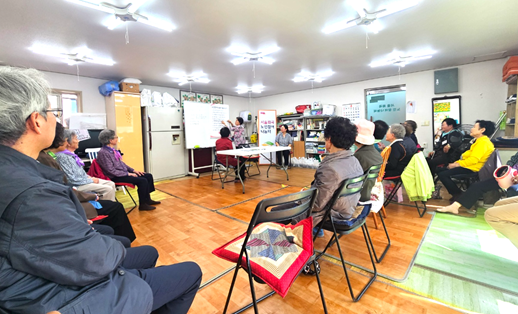
A scene from a weekly meeting at Hwagok Nanumteo. Source: AGAC
Each Nanumteo has a facilitator assigned to support the members’ self-governance—in the case of Hwagok and Sinwol, Park Kyung-mi, introduced later in the piece. But until the last possible moment, when intervention seems truly necessary, the facilitator mostly watches from the side. The meeting itself remains in the members’ hands.
Before the meeting began, the members read aloud from the “Nanumteo House Rules” posted on a board at the front of the room. “Respect other people’s opinions.” “No little circles.” “Follow meeting decisions.” “No money dealings between members.” The wording was plain and a little rough, but it sounded earned and lived-in—bits of practical wisdom gathered through trial and error since the first Nanumteo opened in 2004.
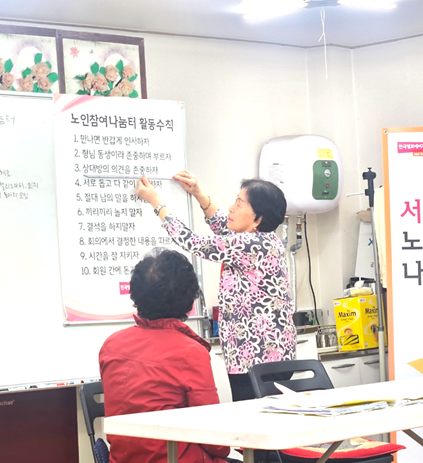
Members reading the house rules before the meeting. Source: AGAC
One item on the agenda that day stood out: whether to hold the “tteokbokki sharing” event for Children’s Day. The room divided into two loose camps: the optimists, who liked the simple idea that they could do something, anything, for the children in the neighborhood, and the more cautious ones, who wondered whether the moms coming along with the children should have some part in the preparations, too.
Hwagok Nanumteo, it turned out, was woven into the neighborhood in more ways than one might expect. At the request of a local youth center, members had taught sock-loop crafts they had first picked up at the Nanumteo, offering their skills as a form of community service. On another occasion, they lent their voices to a festival meant to draw people back to the neighborhood’s traditional market.
And then they got louder still. In 2025, after practicing every Wednesday for a full year, they welcomed the new year by performing spoon-nanta[3] for their neighbors. With busy hands, steady steps, and the occasional burst of noise, they were bringing something useful—and a little color—to the life around them. From time to time, they would donate part of the proceeds from bazaars and other sales back to the community.
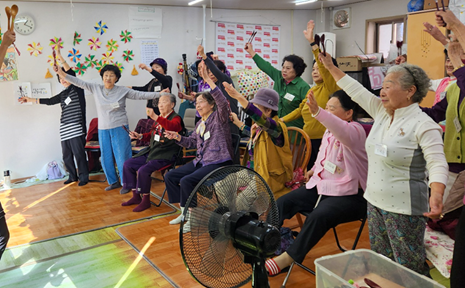
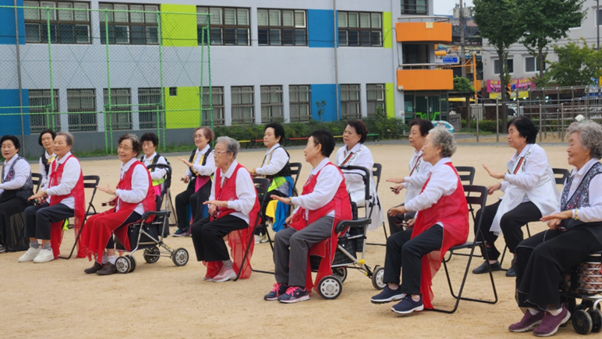
The New Year spoon-nanta performance that brought generations together, on the day itself and in rehearsal. Source: HelpAge Korea official website
According to Park Kyung-mi, the facilitator, a Nanumteo often marks a turn in a member’s life: after being cared for, they begin to turn that care outward. Each week, members receive thoughtfully prepared side dishes; on holidays, there are gifts, too, along with other support from the Nanumteo and the neighborhood. Out of that shared ethic—“bonds,” “self-rule,” “participation and sharing”—a quiet cycle of care was at work: what had been given to them did not stop with them.
Park describes the facilitator’s role as “gathering the members’ thoughts and words, and giving them shape.” If they discuss a neighborhood project they want to take on, she helps turn the talk around the table into a plan. At one local project competition, a proposal Park had drafted from the members’ own meeting was later presented not by Park, but by one of the members herself.
Everything at the Nanumteo begins with patience, and sometimes with the strain of patience. Something a facilitator could finish alone in an hour may take more than a week when done with the members. Just when it seems the group has taken one step forward, the facilitator may find them two steps back. But Park understands that the long wait is not wasted; it is how the members learn to stand on their own.
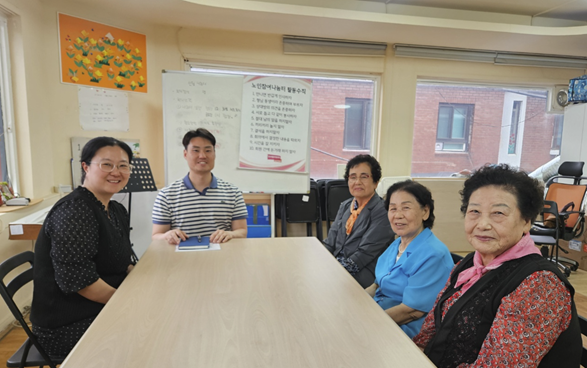
At Sinwol Nanumteo, from left: Park Kyung-mi, facilitator at HelpAge Korea; Hong Ui-yeol, manager at HelpAge Korea; member Lee Kyung-soon; Leader Kwon Jeong-soon; and Deputy leader Park Nan-hee. Source: AGAC
That is why she can also be firm. When someone says they cannot do something, she may draw a clear line: “If you don’t want to do it, you don’t have to.” The goal is to loosen the members’ dependence on the facilitator to let the work once carried by the facilitator pass gradually to the elected leaders, and then from the leaders to everyone else. Her patience has begun to return to her in a small but telling form: she can now go on leave with some peace of mind. Things that once seemed impossible without her—opening the Nanumteo for the day, running meetings, cleaning, and tidying up afterward—are now handled by the members themselves. During one period when Park was away from the site, a member even reached out directly to a local welfare agency and found a new opportunity for collaboration.
Park says she finds it most rewarding when members take the initiative to voice what they want to try and when she is able to help turn those wishes into a workable plan. Many have lived lives marked by deprivation, with limited access to opportunities that might have enriched their life experiences. As a result, stepping beyond familiar boundaries and trying out new things has not been part of their everyday lives. For this reason, a central aim of the Nanumteo project is to encourage members to cross the small borders life has placed around their days. In doing so, the project creates moments where generations meet, while challenging old assumptions and prejudices about age.
Nanumteo refuses to see its members as finished portraits, their lives already complete, their possibilities exhausted. It sees in them a hopeful fluidity—the capacity to learn, change, and continually widen their worlds. Much of Nanumteo’s vitality seems to come from this shared conviction that people can still grow.
The culture of autonomy extends beyond individual sites. Each year, elected leaders from the various Nanumteo communities gather for the Solidarity Meeting, bringing with them the year’s small wins, frustrations, and lessons. The gathering serves as yet another place where “Age helps” is put into practice, as older members draw on their experience and collective wisdom to help one another move forward.
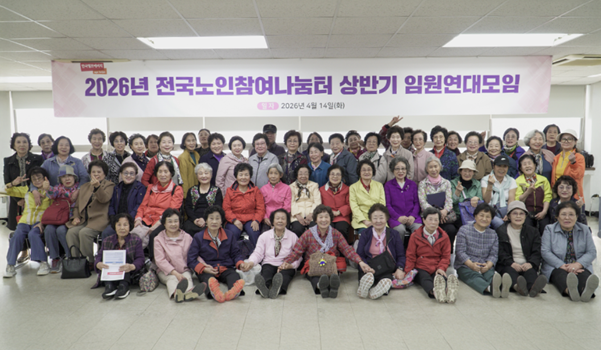
The first-half 2026 National Nanumteo Leaders’ Solidarity Meeting. Source: HelpAge Korea official website
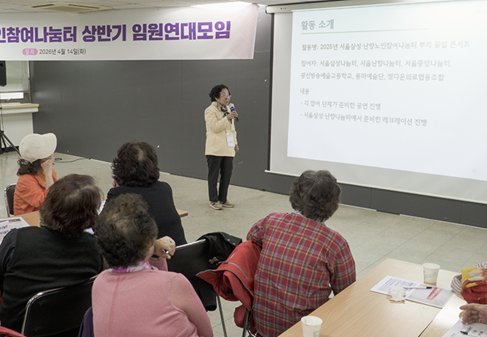
Members presenting the activities of their respective Nanumteo at the first-half 2026 Leaders’ Solidarity Meeting. Source: HelpAge Korea official website
Hong Ui-yeol, the manager overseeing the Nanumteo project, names this capacity for networks as one of the things that sets the Nanumteo apart from other senior facilities, alongside “participation and sharing” and “self-rule.” Across the Nanumteo network, one group’s success can stir another, and one group’s trial and error can become another group’s lesson. Its growth is not best measured by the number of sites opened. The truer measure is the sturdiness of a slow solidarity.
This year, too, the focus has been less on expansion than on depth. More sites across the country would matter, of course. But the judgment was that existing communities first had to be able to keep alive the culture and operating principles that make a Nanumteo a Nanumteo. This is also why HelpAge Korea is cautious about simply increasing the number of members at each site. A self-help community of older people needs time: time to gather members, time for trust to take root, time for people to learn the rules and habits of the group. Sometimes recruitment alone takes more than a year. For a community to find its footing can take longer still.
That’s why recruitment here is a very different thing from finding welfare recipients and filling seats. In the early days of the project, HelpAge Korea staff met low-income older people in the target neighborhoods one by one and introduced the Nanumteo to them. They explained that this was not simply a place to receive support, but a community where members would take part in learning, join in solidarity activities, and practice sharing with the neighborhood. It was not simply an effort to bring people into a room, but to help them see themselves again as actors in their own lives.
That is hard work. For older people who have grown used to thinking, “I am old and ill; there is nothing I can do,” believing again in their own possibility does not happen on command. There have been misunderstandings along the way, too—some have mistaken the Nanumteo for a religious cult or a group with a commercial purpose. Even so, HelpAge Korea has held to this slow way of working.
The same patience governs the way new members are brought in. They do not simply sign up. They come for three straight weeks, to meetings usually held at least twice a week, and they are expected not to miss a session. In those weeks, they learn the room—its pace, rules, and small obligations—and then decide whether to join. If they miss a meeting, even for an unavoidable reason such as health, they start again from week one. It is a rule that can look, at first glance, overly strict, even inefficient.
But these are the very steps that have allowed members, today, to carry the Nanumteo’s identity and principles as promises of their own. For the same reason, when selecting partner organizations to operate new Nanumteo sites, HelpAge Korea gives strong weight to whether the applicant truly understands the purpose of the project and the patience it requires.
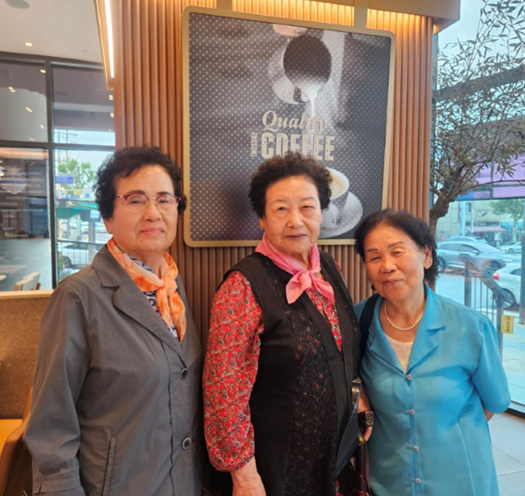
From left: Lee Kyung-soon, Park Nan-hee, and Kwon Jeong-soon of Sinwol group. Source: AGAC
At Sinwol Nanumteo[4], AGAC spoke with Kwon Jeong-soon, the group’s elected leader; Park Nan-hee, its deputy leader; and Lee Kyung-soon, a member. They shared vivid accounts of how their lives had changed since joining Nanumteo and how much this modest space had come to mean to them. Having joined the group through different paths, each described the place, in her own way, as “a community of everyday mutual care.”
Kwon is now in her third year as leader of the Sinwol group. Before this, she served as its coordinator. For much of her younger life, she worked hard, but rarely stood at the front of a group. Now in her eighties, she is navigating a completely different kind of public life, carrying the everyday duties of elected leadership.
And these duties are not ceremonial. Each time the group meets, the leader and deputy leader mark attendance and welcome the members as they arrive; help run the weekly meetings; and keep an eye on safety when the group goes out. They visit members at their hospital bedsides. If the person assigned to clean falls ill, they often take up the mop themselves. There is nothing grand about these tasks—keeping time, holding order in a meeting, reminding people of the rules, noticing who is frail or missing. Yet together, they make a quiet argument: leadership in later life does not need formal settings or a long résumé.
Asked what makes Nanumteo different from standard senior services and facilities, Park and Lee spoke first of its “family-like warmth.” Then they noted something just as vital: how the group makes room for each member’s own pace and physical limits. It is a place, they said, where people do not talk behind one another’s backs, but listen and take one another in. Their description says a great deal about the spirit of the group.
Lee, who joined three years ago, remembered having to drop out of an autobiography-writing class at a community welfare center because of her hearing difficulty. Her story points to a wider problem. Many senior services mean well, but still struggle when confronting the uneven realities of those who come through their doors—whether that means limited income, failing health, impaired hearing or sight, or brittle confidence. At Nanumteo, by contrast, getting it right is not the point. Members ask again, help one another, and get there together at a pace the room can share.
Park offers another example: the annual Silver Sports Day, held every October for members from Nanumteo groups across the country. The interviewees appreciated that the event was designed with older bodies in mind, allowing them to enjoy physical activity without feeling pushed too hard. They also described the sense of safety they felt in a place where leaving no one behind mattered more than who performed best.
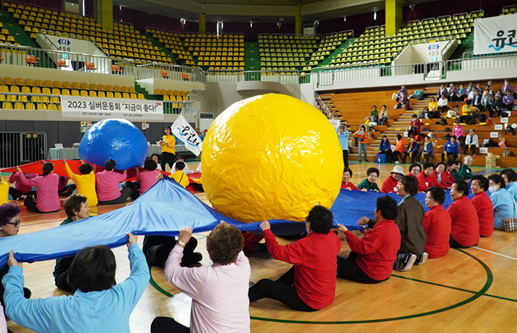
A Wave Relay event at the 2023 Silver Sports Day. Source: HelpAge Korea official website
What AGAC glimpsed at the two Nanumteo groups in Hwagok and Sinwol was not some vague ideal dressed up in institutional language, but a lived reality animated daily by each member’s sense of autonomy, responsibility, and commitment. The visits offered reason to hope that the rights set out in Korea’s Framework Act on the Human Rights of Older Persons, currently under legislative review—particularly the rights to independence and autonomy, participation, and self-fulfillment—need not remain distant aspirations; they can take shape as a way of life.
The evidence was in the small scenes: members raising their hands to speak in meetings; deciding the year’s activities together; slowing their steps for someone with limited mobility; teaching children a craft they only recently mastered; putting a portion of their modest proceeds back into the neighborhood. Taken together, these moments demonstrate that needing support does not cancel agency. Older persons can still have a say in their own lives, give something back to the places they live, and find one another along the way.
Even now, the Sinwol and Hwagok Nanumteo groups are moving slowly but not vaguely. Step by step, they are building a vision of later life that is not reduced to charity, protection, or care, but rests instead on reciprocity, agency, and the stubborn, everyday work of belonging.
[1] https://www.helpage.or.kr/business/divide/
[2] Twenty members take part, with an average age of 85.
[3] Spoon-nanta is a Korean rhythm performance in which ordinary kitchen spoons, wooden or stainless-steel ones, become percussion instruments, tapping out quick, synchronized beats to lively music.
[4] Twenty members take part, with an average age of 85.8.