[Case 33] A Digital Lifeline for the Isolated: Inside Seoul’s AI- and IoT-powered Smart Check-In Service
작성자 ADMIN
날짜 2026-01-27 10:51:10
조회수 8693
A Digital Lifeline for the Isolated: Inside Seoul’s AI- and IoT-powered Smart Check-In Service
Intro
Rising single-person households and fraying community ties amid rapid population ageing are fueling social isolation. The risk is especially pronounced in later life, when pressures often converge: declining health, a diminished social role after retirement, and the weakening of long-standing relationships. In times of crisis, older adults living alone are particularly vulnerable to delays in receiving the right response, as it may take time for others to notice and take action.
This is why social isolation is increasingly treated not as a private hardship, but as a structural challenge that communities must tackle together. Seoul—home to the nation’s second-largest population after Gyeonggi Province, and ranking second among Korea’s 17 cities and provinces both in the size of its older population and in the number of solitary deaths—has placed the issue squarely on its policy agenda. Under the banner of “a Seoul where loneliness has no place” the city has rolled out a range of initiatives to respond to loneliness and isolation.
Among them is the Seoul Smart Check-In Service, which is drawing attention as an effort to build a faster, more responsive safety net. Equipped with AI and IoT features, it confirms residents’ well-being more reliably and connects at-risk households with the support and services they need before a warning sign becomes an emergency.
Technology That Reconnects People: Seoul’s Smart Check-In Service
Seoul’s Smart Check-In Service is designed for households at risk of social isolation—such as older adults living alone and single-person households in midlife. Its aim is to spot early signs of disruption in daily routines, automate well-being checks and first-line responses, and activate the city’s care workforce and administrative response system when warning signs emerge—so risks are not overlooked and help arrives before it is too late.
First introduced in October 2022, the initiative is offered in five formats as of 2025: Smart Plug, Smart Safety Check, AI Safety Care, Single-Person Household Care, and AI Wellness Check. At its core, the service is built on three elements:
1. IoT-based sensing of daily-life data,
2. AI-enabled, non-face-to-face check-ins, and
3. a coordinated response that links detected risk to administrative and care personnel.
Across these five formats, the program largely falls into three delivery models.
First, the Smart Plug model installs a smart plug in the home to track indicators such as electricity use, changes in indoor light levels, and appliance-use patterns. When the system detects a shift from a resident’s usual rhythm, the signal is routed to relevant staff and monitoring channels for follow-up.
Second, Smart Safety Check, AI Safety Care, and Single-Person Household Care combine multiple indicators—such as telecommunications/mobile-phone usage patterns and electricity consumption—and use AI to analyze risk signals. When warning signs are flagged, the system can trigger steps such as automated check-in calls and, if needed, on-the-ground visits to confirm the person’s safety.
Finally, AI Wellness Check conducts regular check-ins through AI voice calls. If high-risk language or alarming statements are detected during a call, the system initiates an appropriate response to ensure timely intervention.
Below, Table 1 provides a snapshot of the five formats and their operational details.
[Table 1: Overview and current status of Seoul’s Smart Check-In Service (as of September 2025)[i]]
|
Category |
Description |
Operating partner |
No. of districts offering the service |
Users(approx./unit: households) |
|
Smart Plug |
Installed in the home to measure electricity use and light levels → triggers follow-up when no use is detected |
A-Nine, Dawon DNS |
21 |
3700 |
|
Smart Safety Check |
Detects risk by analyzing electricity use, door-opening activity, step counts, and call history |
Lucis Co., Ltd.
|
8 |
2200 |
|
AI Safety Care |
Detects risk by analyzing electricity use, telecom data, and mobile-phone activity (e.g., charging/lock status) |
Korea Electric Power Corporation (KEPCO), SK Telecom (SKT), Happy Connect |
4 |
100 |
|
Single-Person Household Care |
Detects risk by analyzing electricity use and telecom data |
KEPCO, SKT, KT, LG |
8 |
1600 |
|
AI Wellness Check |
An AI system places automated calls once a week to check on enrolled recipients |
NAVER Cloud |
20 |
10,000 |
Seoul operates the program in collaboration with a wide network of partners, including district offices, community service centers, and private service providers. The city government sets the overall direction of the initiative, allocates the budget, finalizes program components, and encourages participation across Seoul’s districts. Each district then decides which services to offer based on local needs, contracts with service providers, and executes the budget; providers, in turn, supply the technology and run day-to-day operations. Meanwhile, community service centers recruit and manage participants and handle weekday, daytime monitoring of risk alerts and field responses.
Coordinating this multi-actor system is the Seoul Isolation Prevention Center, established by the city government as a specialized institution for preventing and responding to loneliness and social isolation. The Center is responsible for nighttime monitoring on weekdays and monitoring/dispatch on weekends and holidays[ii]. It also oversees service quality, including staff training, service upgrades, suitability assessments, and follow-up monitoring[iii].
Rather than a stand-alone “tech solution,” Seoul’s Smart Check-In Service is designed to support and extend existing elder-care delivery systems. Within the program, AI classifies daily-life signals and participants’ responses to identify risk alerts. When abnormal signs are detected, the system automatically relays the alert to either the relevant community service center or the Smart Check-In monitoring center housed within the Seoul Isolation Prevention Center—triggering, as needed, a follow-up phone call by staff or an in-person visit for urgent response. In other words, the model aims to detect early when social isolation is intensifying toward crisis, and to enable timely public intervention by linking people to the right support and services.
Among the five formats currently in operation, the two most widely used on the ground are the Smart Plug and AI Wellness Check services. As of 2025, these are provided in 21 and 20 of Seoul’s 25 districts, respectively. Detailed descriptions of each service follow.
1. Smart Plug: Detecting “Silent” Warning Signs
The Smart Plug is a non-obtrusive, passive device installed on frequently used household appliances such as TVs, electric kettles, and lighting. It detects changes in electricity use and flags abrupt shifts in daily routines without requiring any user response or engagement. If there is no power usage for a set period, or if usage continues in a pattern that deviates sharply from the person’s usual hours, the system classifies the alert by severity as “attention,” “risk,” or “serious”.
Once a resident is enrolled, staff at the local community service center install the smart plug in the home. They also set a personalized detection window based on the individual’s level of isolation risk—for example, 24 hours for ‘high risk’, 36 hours for ‘risk’, and 50 hours for ‘normal’.
During the day, alerts are monitored by community service center staff; at night, monitoring is handled by the Seoul Isolation Prevention Center’s control room. When an alert is generated, staff confirm the person’s safety by phone call or text message. If they are unable to reach the person, they conduct an in-person visit. Where necessary, they work with 119 and 112 to carry out location tracking, forced entry, and emergency measures.
One of the Smart Plug’s key strengths is its simplicity: installation is straightforward, and it requires no active input or response from the user. This makes it particularly useful for vulnerable households with low digital access such as homes without internet or Wi-Fi, or residents who are not comfortable using smartphones. Because it is installed only on selected appliances, it is also seen as less privacy-invasive than other models that combine broader data sources such as electricity consumption and telecommunications records.
A limitation, however, is that it may not enable an immediate response if a resident collapses suddenly. In many cases, a risk signal is detected only after time has passed. For that reason, some have argued for adding a preventive, user-initiated emergency request function[iv].
[Figure 1: How to install a Smart Plug[v]]
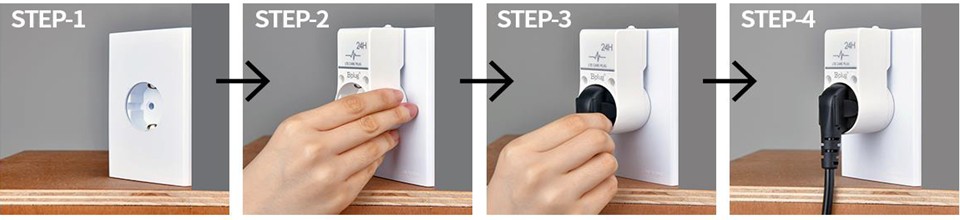
Step 1: Preparation for installation
Step 2: Attach the device
Step 3: Plug in the appliance
Step 4: Installation complete
[Field response case 1: Rapid intervention during a heatwave alert for a middle-aged person living alone[vi]]
- Profile of the individual
-Middle-aged person living alone
-Living with chronic conditions (including liver disease and neuropathic pain); malnourished
-Suspected alcohol dependence; signs of cognitive decline
-In a state of social isolation
- Why a field visit was triggered
-A risk signal was detected during intensified monitoring of single-person households after a heatwave alert was issued.
-No change in Smart Plug electricity usage; the television remained off for an extended period
→ A phone check and an in-person visit were initiated
- Conditions on arrival
-The individual was found lying down in the afternoon during the heatwave alert, with little to no consciousness.
-High indoor temperature; strong odor and severe contamination
-Extremely poor hygiene conditions; multiple empty alcohol bottles were found
- Immediate actions taken
-Transported by 119 emergency services
-An emergency case conference convened (8 agencies participated, including the Health Management Division, the LH(Korea Land & Housing Corporation) Housing Safety Center, a visiting nursing service, and a specialized cleaning contractor)
-Multi-agency referrals and coordinated follow-up initiated (temporary protection at a climate shelter, professional disinfection and cleaning, food support, etc.)
- Follow-up support
-Housing environment: professional disinfection and cleaning
-Emergency support: heatwave shelter, donated groceries, nutritional meals
-Health support: temporary convalescent hospital care, visiting nursing services
-Rebuilding connections: family counseling, reconnection with emergency contacts
-Housing transition: application submitted for an LH rental housing program
2. AI Wellness Check: Companionship calls with safety checks
AI Wellness Check is a service in which an AI system calls participants once a week on a regular schedule, reaching out to users at risk of social isolation to check in, exchange a brief conversation, and automatically log the call so that staff at community service centers and monitoring centers can review what took place. If the call does not connect, the AI automatically redials. If a user misses the call repeatedly beyond a set threshold, or if they report difficulties and request welfare counseling, the service operator’s monitoring center first attempts a follow-up call and then relays the case to the community service center. A second-stage response follows, led by community service center staff and welfare planners, who conduct counseling and arrange subsequent support as needed.
A major driver of the AI Wellness Check’s widespread uptake is digital inclusion. Because it relies on an approach older adults are already comfortable with—ordinary phone calls—it is more accessible than formats that require additional digital steps, such as installing an app. The service can be delivered via a participant’s landline or mobile phone, with no need to install extra devices or learn how to use them.
From an operational standpoint, the service can also be run reliably with a relatively small team. After placing calls, the AI automatically sends designated staff an email report summarizing call outcomes and conversation analysis. Because the system can reach many users at once and surface unusual signals through call monitoring, it helps staff at community service centers and monitoring centers identify potential warning signs quickly and respond without delay.
[Figure 2: AI Wellness Check Service Workflow]
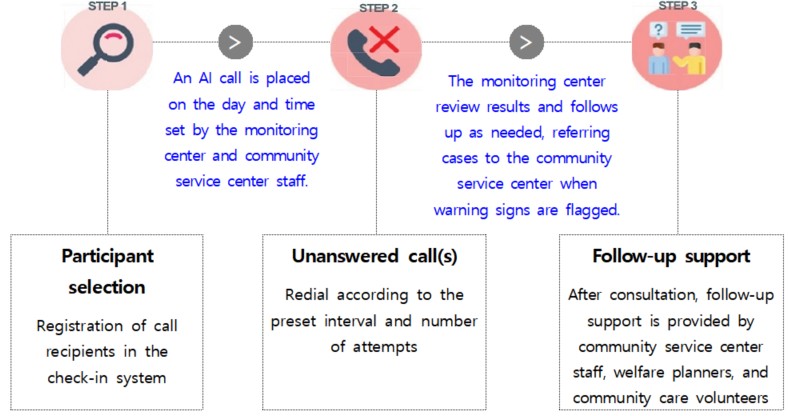
Source: Reconstructed from materials in the booklet for the 1st Case Seminar on Smart Technology Transforming Seoul Welfare (Seoul Isolation Prevention Center)
[A sample dialogue showing how the AI checks in while naturally weaving in questions about the user’s health[vii]. It remembers earlier exchanges and carries the context forward]
(AI): By the way, have you been keeping up with your walking routine?
(User): Yes—I just took a walk in the neighborhood park.
(AI): That’s impressive—you’re setting a great example.
------------------------------------------------------------------------------------------------------------
(AI): And about your last health checkup—have your results come back yet?
(User): I’m still waiting for them.
(AI): I see. I hope you get good news.
------------------------------------------------------------------------------------------------------------
(AI): I’m calling to check in—how are you? Have you been feeling any discomfort lately?
(User): I’m doing a bit better.
(AI): That’s good to hear. And how’s your cold?
(User): It’s almost gone.
(AI): I’m really glad to hear that. I hope you continue to stay well.
------------------------------------------------------------------------------------------------------------
Users of the AI Wellness Check service said that simply receiving a call that asks how they are doing gives them a sense of being remembered—something they find comforting and helpful in easing loneliness, however modestly. They added that the calls feel responsive despite being AI-driven, and that it is reassuring to know the service can connect them to a community service center when needed[viii].
Seoul has also announced in a recent press release that the AI Wellness Check will be upgraded from a one-way to a two-way system. In addition to making scheduled check-in calls, the upgraded system will also be able to answer incoming calls from users. When a user calls the two-way AI Wellness Check to request assistance, the request will be relayed directly to the relevant local service point, such as a community service center. If a user needs a human conversation, the service will connect them to “Goodbye Loneliness 120”, a call center staffed by trained counselors specializing in loneliness prevention. Seoul added that it will continue refining the service, for example, by allowing users to choose the AI’s gender and voice tone[ix].
[Field Response Case 2: Identifying a Voice-Phishing Victim Through the AI Wellness Check[x]]
A middle-aged person living alone who had been using the AI Wellness Check service suddenly stopped answering the AI’s regular check-in calls. The monitoring center flagged the change as abnormal and attempted to reach the user directly, but the user’s mobile service had been suspended.
The monitoring center immediately notified the local community service center and requested a welfare check. During an in-person visit, the assigned welfare officer found that the user had recently fallen victim to voice phishing, suffering financial losses of roughly KRW 1 million (or USD 682). He had been unable to pay even his phone bill, and his mobile service had been cut off.
The community service center reported the case to the police and, to support the user’s financial recovery, applied to Good Neighbors (an NGO) for its Voice-Phishing Victim Support Program. The user was accepted into the program and was able to receive full compensation for the amount lost.
Without the AI Wellness Check, early detection of the user’s distress would likely have been far more difficult. In this case, the service functioned as a critical channel that helped translate an early warning into timely, concrete support.
Follow-up monitoring: From episodic responses to sustained care
The Center conducts follow-up monitoring for households deemed at risk of social isolation. This includes users who have required an in-person response, who need support with meals, finances, medical care, housing, or emotional well-being, or whose AI calls include high-risk language, including references to depression, suicide, or death.
As an initial step, the Center conducts phone-based fact-finding with the individual and relevant partners such as the local community service center to assess the person’s current circumstances and social ties. It also reviews what welfare services have already been linked and what support is being provided by the district and community levels, as well as by private organizations.
The Center then checks whether case management is in place. If not, it initiates case management and connects the individual to appropriate welfare agencies. If case management is already underway, the Center shares any additional information it has identified with the case-management provider and requests closer, more intensive follow-up.
Follow-up monitoring candidates selected from the initial monitoring pool through a monthly internal review are then assessed again by the Center. The Center rechecks the person’s current situation and any services already linked, and continues to evaluate whether the support in place remains appropriate over time.
This follow-up track ensures that the Smart Check-In Service goes beyond risk detection and one-off responses, supporting a longer arc of care that can improve living conditions and help rebuild social ties. Integrated into case management, the service’s findings help make public intervention for social isolation more continuous and sustained.
In Closing
Seoul’s Smart Check-In Program offers a compelling illustration of what AI and IoT can contribute to later-life care. What makes it distinctive is its role as a connecting hub—linking community-based care networks, frontline staff, and support schemes to enable early detection of warning signs and timely follow-up. By helping older residents sustain their everyday lives where they have long lived while staying connected to support beyond the home, the service points toward technology that can make ageing in place more attainable and more scalable.
Still, technology is no silver bullet for social isolation. Elder care remains, at its core, a matter of people, relationships, and community. Used well, technology reinforces that foundation: tightening the safety net, bringing risks to light earlier, and enabling interventions that are timely and proportionate.
Looking ahead, Seoul’s Smart Check-In Service faces two clear priorities: aligning efficiency gains with older persons’ rights, and strengthening integration with community-based care systems.
References
-Seoul Isolation Prevention Center. Booklet for the 1st Case Seminar on Smart Technology Transforming Seoul Welfare (Identifying and Supporting Socially Isolated Households through Smart Technology).
-Seoul Welfare Foundation. 2024 Satisfaction Survey Report on Seoul’s Smart Care Services (2024).
-Seoul Metropolitan Government (Press Release). 24/7 Monitoring of Single-Person Households at Risk of Solitary Death in Seoul: “We Will Find Them, No Matter What” (February 9, 2023).
-Seoul Metropolitan Government (Press Release). Seoul’s “AI Wellness Check” Service Upgraded from One-Way to Two-Way Communication (October 21, 2025).
[i] Reconstructed from materials on the Seoul Isolation Prevention Center website (https://sihsc.welfare.seoul.kr/knockseoul/030401/C00020/contents.do) and Seoul Metropolitan Government press releases (October 11, 2025; October 21, 2025).
[ii] Excluding the AI Wellness Check service, which is monitored directly by the service provider(s).
[iii] Positioned as a metropolitan-level control tower for responding to loneliness, social isolation, and withdrawal, the Seoul Isolation Prevention Center was launched within the Seoul Welfare Foundation in October 2022, the first initiative of its kind nationwide. It was later renamed the “Seoul Isolation Prevention Center” as part of Seoul’s broader “Seoul Without Loneliness” agenda. The Center runs a portfolio of related initiatives, including “Goodbye Loneliness 120,” a gateway for preventing and easing loneliness, as well as tailored programs for isolated and withdrawn households and efforts to strengthen local welfare systems. Seoul’s Smart Check-In Service is one pillar within that wider package.
[iv] Seoul Isolation Prevention Center. Booklet for the 1st Case Seminar on Smart Technology Transforming Seoul Welfare (Identifying and Supporting Socially Isolated Households through Smart Technology).
[v] Seoul Metropolitan Government (Press Release). 24/7 Monitoring of Single-Person Households at Risk of Solitary Death in Seoul: “We Will Find Them, No Matter What” (February 9, 2023).
[vi] Reconstructed from a “Smart Welfare” support case posted on the Seoul Isolation Prevention Center website (https://sihsc.welfare.seoul.kr/knockseoul/030404/board/case/2210.do).
[vii] CLOVA CareCall’s Challenge and Innovation in Generative AI Cloud Services (Smart Cloud Show presentation materials; hosted by Korea’s Ministry of Science and ICT).
[viii] Seoul Welfare Foundation. 2024 Satisfaction Survey Report on Seoul’s Smart Care Services.
[ix] Seoul Metropolitan Government (Press Release). Seoul’s “AI Wellness Check” Service Upgraded from One-Way to Two-Way Communication (October 21, 2025).
[x] Seoul Isolation Prevention Center. Smart Welfare Support Case (https://sihsc.welfare.seoul.kr/knockseoul/030404/board/case/788.do).